Protector Safety PROTECTOR SAFETY IND CO., LTD.
Industry

26 firefighters die battling China forest fire

On 30 March 2019 a wind change turned a forest fire in Muli County, Sichuan into a blow-up. The events, the toll, and the safety lessons.

← Back to all news
Industry Published 2019-04-01 Reading time 5 min
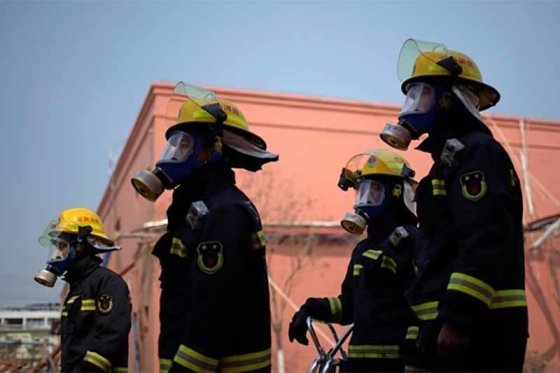
Four firefighters in full protective equipment and breathing apparatus

On the evening of Saturday 30 March 2019 a forest fire broke out in Yalongjiang Township, Muli County, in the Liangshan Yi Autonomous Prefecture of Sichuan Province, at an altitude of more than 3,800 metres. The following day, some 689 firefighters and local fire crew reached the scene on foot, carrying roughly 15 kg of equipment each over steep, densely wooded ground.

Key takeaways

  • A sudden change in wind direction caused an outburst of the fire — the event reports describe as a blow-up — which trapped the crews.
  • On 1 April 2019 the authorities confirmed that 26 firefighters had died; the final toll reached 31, including 27 members of the forest fire brigade.
  • The crews involved were recognised nationally for their actions, and the event became a case study in forest-fire behaviour and crew safety.
  • For equipment suppliers, it is a reminder of why approved, tested and correctly maintained kit matters at the extremes.

What happened

The fire started in remote mountain terrain. Because the flames threatened villages further down the valley, crews moved into the original forest to cut them off. By the afternoon of 31 March the open flame had largely been knocked down, and the crews were working their way around two remaining smoke points when the wind direction changed abruptly. The result was a sudden, violent flare-up of the fire front — the phenomenon firefighters call a blow-up — which engulfed the positions the crews were holding.

The toll

On 1 April 2019 the authorities in Liangshan confirmed that 26 firefighters had died and that search teams were still looking for missing personnel. The final official total was 31 lives, among them 27 members of the Xichang forest fire brigade — one born in the 1980s, twenty-three in the 1990s and two in the 2000s — together with local personnel who had been guiding and supporting the operation.

The crews were later named among China Central Television's “Touching China 2019” figures of the year, and the anniversary is marked annually by the national fire and rescue service.

Why forest fires behave like this

  • Wind dominates. A change of direction, even briefly, can turn a flank into a head fire and move it faster than a person can run uphill.
  • Slope multiplies the speed. Fire travels much faster up a slope than across flat ground, and preheats the fuel ahead of it.
  • Blow-ups are sudden. Accumulated unburnt gas ignites almost simultaneously, producing a wall of flame with very little warning.
  • Altitude and terrain slow the crews down. At 3,800 metres, carrying 15 kg, the time available to withdraw is short.

The safety lessons

  1. Escape routes and lookouts come first. Every crew needs a designated escape route and a dedicated lookout whose only job is to watch the fire and the wind.
  2. Know when to disengage. Direct attack on a head fire in heavy fuel, on steep ground, with an unfavourable wind, is a losing position.
  3. Protective equipment has to be certified and serviceable. Fire shelters, protective clothing and respiratory protection only perform as designed when they are listed, in date and undamaged.
  4. Communications and weather data save lives. Real-time wind information and reliable radio contact are as important as pumps and hose.
  5. Water supply at the scene must be dependable. Remote operations depend on pumps, hose and couplings that work first time, at pressure, in poor conditions.

What it means for the fire protection industry

Wildland fire and building fire protection are different disciplines, but they share one premise: equipment is only as good as its certification and its maintenance record. Protected structures, hydrant networks and the reliability of water supply at the edge of a wildland interface are what allow a fire to be fought from a defensible position rather than from inside the flame front.

Need a specification or quotation?

Send us your project requirements — our engineers will respond within one business day.