Use of fire hose interface and water separator
Read article →
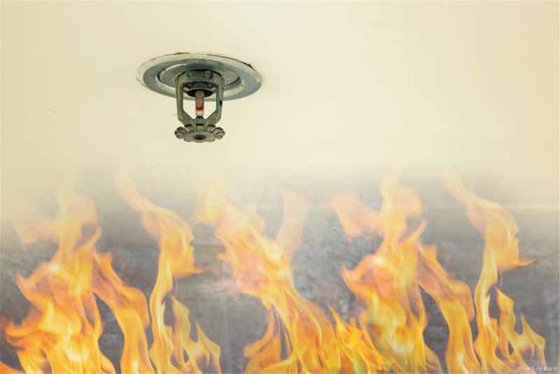
Two sprinkler systems with the same pipe sizes can behave very differently because the heads are different. Four choices decide almost everything: pattern (which way the water is thrown), temperature rating (when it opens), response type (how fast it reacts) and K-factor (how much water it can deliver).
| Pattern | Where it is used | Notes |
|---|---|---|
| Pendent | Below the ceiling, water thrown downwards | The default choice for exposed and finished ceilings; a recessed or concealed cover plate keeps the ceiling line clean. |
| Upright | Above the pipe, water thrown up onto a deflector then down | Common in warehouses, car parks, mezzanines and where the pipe is exposed and the head would otherwise be damaged. |
| Sidewall | On a wall or beam, throwing water outwards across the room | For corridors, hotel rooms, small rooms and retrofit work where there is no ceiling void. |
| Concealed / recessed / flush | Below a finished ceiling, hidden behind a cover plate | Chosen for appearance in hotels, offices and retail; the cover plate falls away before the head operates. |
| Conventional (old-style) | Legacy installations | Throws water up and down; no longer the preferred pattern for new work. |
Glass-bulb sprinklers use a standard colour code so an inspector can read the rating from the floor. Ratings are selected at least about 20 °C (36 °F) above the highest expected ceiling temperature, so an unheated space and a boiler room do not get the same head.
| Bulb colour | Rating | Typical location |
|---|---|---|
| Orange | 57 °C / 135 °F | Cooler spaces, cold stores, some residential work |
| Red | 68 °C / 155 °F | The ordinary-temperature default for most commercial buildings |
| Yellow | 79 °C / 175 °F | Warmer areas, some skylights and glazing zones |
| Green | 93 °C / 200 °F | High ambient heat, near heaters and ducts |
| Blue | 141 °C / 286 °F | Very high ambient temperature, industrial plant |
| Purple | 182 °C / 360 °F | Extreme heat locations |
| Black | 227 °C and above / 440 °F+ | Special high-temperature applications |
Response type describes how quickly the heat-sensitive element reacts, expressed as a Response Time Index (RTI). Quick-response heads have a small, thin bulb and react fast — they are the normal choice where life safety is the objective, such as offices, hotels and residential occupancies. Standard-response heads react more slowly and are still used in some storage and high-challenge designs, where the fire is expected to grow large enough to operate several heads.
The practical rule: never mix response types on the same system unless the design says so, and always replace a head with the same model or a listed equivalent.
The UL Listed sprinklers in our UL Listed sprinkler range cover K5.6 and K8.0 in upright, pendent, sidewall and conventional patterns, in quick- and standard-response versions.
Send us your project requirements — our engineers will respond within one business day.