Types of fire sprinkler heads and how to choose them
Read article →

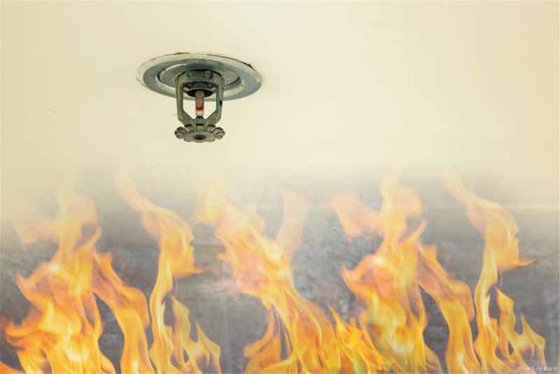
An automatic sprinkler system is a permanently installed network of pipes and individually heat-operated sprinkler heads, connected to a reliable water supply. Each head is a heat-actuated valve. When the air around one head reaches its rated temperature, that head — and only that head — opens and sprays water on the fire below.
| Type | Pipes hold | Water reaches the head | Typical use |
|---|---|---|---|
| Wet pipe | Water, always | Immediately | Heated buildings, offices, hotels, most warehouses |
| Dry pipe | Compressed air | After the air escapes and the dry valve opens (a short delay) | Unheated warehouses, cold stores, loading docks |
| Preaction | Air (single interlock) or air with a charged pipe (double interlock) | Only after detection confirms a fire | Data centres, museums, freezers — places where a false trip is expensive |
| Deluge | Open, no water | All heads discharge together on detection | High-hazard, fast-spreading fires: fuel, foam-water, flammable stores |
The flow constant or K-factor links the pressure at the head to the volume of water it will deliver:
Q = K × √P
with Q in litres per minute and P in bar (metric convention). Common values in commercial and light industrial work are K5.6 (K80) for ordinary-hazard areas and K8.0 (K115) where more water is needed, such as storage or high-challenge occupancies. Larger K-factors (K11.2, K14.0 and above) are used for storage protection and ESFR designs.
The metric and imperial numbers describe the same head: K5.6 in gpm/√psi is roughly K80 in l/min/√bar, and K8.0 is roughly K115.
Because the sprinkler head is the component that actually makes the decision, its listing, temperature rating and finish have to match the environment. A head listed for one temperature range used in the wrong location may operate late, or not at all. PROTECTOR SAFETY manufactures UL Listed and FM Approved sprinklers in K5.6 and K8.0 upright, pendent and sidewall patterns — see the product range for the full model list.
It is a permanently installed network of pipes and individually heat-operated sprinkler heads connected to a reliable water supply. When the air around a head reaches its rated temperature, the heat-sensitive element (a glass bulb or fusible link) breaks and that head — and only that head — opens, spraying water on the fire below. The resulting water movement trips a flow switch or alarm valve, which raises the alarm.
No. Sprinklers open individually, one at a time, close to the fire — the film image of a whole building being flooded at once is not how they work. A fire is usually controlled or extinguished while still small, typically by one or two heads.
Wet pipe: pipes always hold water, immediate discharge — most offices, hotels and warehouses. Dry pipe: pipes hold compressed air, water arrives after a short delay — unheated buildings and cold stores. Preaction: water is admitted only after detection confirms a fire — data centres and museums. Deluge: open heads all discharge together on detection — high-hazard, fast-spreading fires.
The K-factor is the flow constant linking pressure to water delivery: Q = K × √P. K5.6 (roughly K80 metric) is the common ordinary-hazard size; K8.0 (roughly K115) is used where more water is needed, such as storage occupancies. Larger K-factors (K11.2, K14.0 and above) serve storage protection and ESFR designs.
Design and installation are governed by NFPA 13, EN 12845 or the local equivalent. Inspection and maintenance normally follow NFPA 25, including weekly gauge checks, annual flow tests, and replacement of any head that has operated or been damaged.
Send us your project requirements — our engineers will respond within one business day.