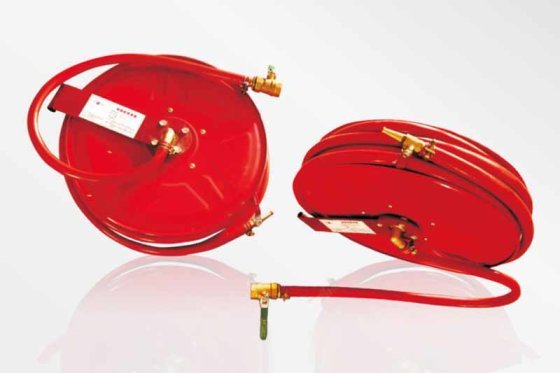
In fire-fighting language the “interface” is the hose coupling — the
fitting that joins hose to hose, hose to hydrant, and hose to nozzle. A water separator
(breeching, dividing breeching or manifold) is the fitting that splits one incoming line into two, three or
four outgoing lines, so a single pump or hydrant can supply several crews.
Both are small, inexpensive parts. Both are also the most common cause of a lost water supply.
Key takeaways
- Standard working pressure for fire hose assemblies is roughly 10–20 bar, with certification
burst tests up to around 40 bar.
- Coupling types are not interchangeable — Storz, instantaneous, threaded and cam-lock each need
their own adapters.
- Open valves slowly. Rapid opening causes water hammer, which is what pulls couplings apart.
- Gaskets are the wearing part: inspect them at every use, replace at the first sign of cracking.
Coupling types at a glance
| Type | How it locks | Connect time | Mainly used in |
|---|
| Storz (sexless) | Half-turn, interlocking lugs | 3–5 s | Continental Europe and internationally; 25–150 mm |
| Instantaneous (snap) | Quarter-turn plus spring lock | under 2 s | UK, Australia, Commonwealth; 38 mm and 70 mm |
| Threaded (screw) | Male/female thread, spanner-tightened | 15–40 s | Industrial plants and permanent installations |
| NH / NST (pin lug) | Thread with lugs for a spanner | 20–40 s | North America; 1.5 in, 2.5 in handlines, 4.5 in steamer |
| Cam-lock | Lever cams into a groove | 3–5 s | Industrial transfer, large-diameter supply |
Body materials are normally an aluminium alloy (light), brass (corrosion resistant, traditional) or
stainless steel (aggressive environments). Whichever you use, the coupling, the hose and the appliance it
connects to must share one standard — or be bridged with a listed adapter.
The water separator in practice
A water separator has one inlet and two to four outlets, each with its own valve and usually a pressure
gauge. It is used to:
- run several hose lines from a single pump or hydrant, instead of laying duplicate mains;
- supply a foam line and a water line from the same source;
- let crews open and close individual lines without shutting down the whole supply.
Its mirror image is the collector (siamese): two or three inlets feeding one outlet, used
when a pumper is charged from more than one source. The related relay arrangement uses
separators and collectors alternately to push water over long distances.
Connecting a hose line, step by step
- Check first. Look at the gasket, the lugs or threads, and the hose jacket. Discard
anything with a cut, a loose coupling or a hardened gasket.
- Align and connect. For Storz, push and give a half turn until the lugs lock. For a
threaded coupling, hand-tighten then finish with a spanner — do not overtighten.
- Lay the line out without kinks or sharp bends, and keep couplings off the ground where
vehicles or debris can strike them.
- Charge slowly. Open the hydrant or pump valve gradually. This is the single most
effective way to avoid water hammer and a burst connection.
- Check for leaks and re-seat anything that weeps. A light initial seepage at the gasket
may take up slightly under pressure.
- Shut down in order: pump first, then the line valves, then the nozzles — and drain
and dry everything before it goes back on the appliance.
Maintenance that prevents failures
- Clean threads and grooves after every use; grit is what seizes a coupling when you need it.
- Lubricate only with the lubricant the manufacturer specifies — petroleum products attack rubber gaskets.
- Replace gaskets rather than reusing hardened ones. This is the cheapest maintenance item in the whole system.
- Service-test hose assemblies at the interval required locally (commonly annual), typically to
1.5 times the working pressure, and record the results.
- Store hose and couplings dry, out of sunlight, and off concrete floors.